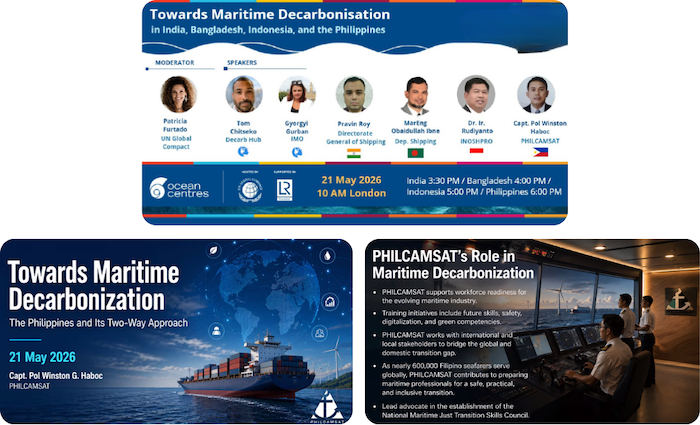
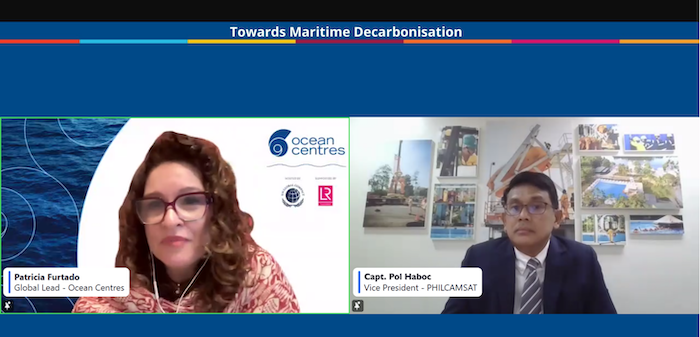
PHILCAMSAT’s Capt. Pol Haboc proudly represented the Philippines at the regional dialogue “Towards Maritime Decarbonization,” held on May 21, 2026, bringing together maritime leaders and experts from India, Bangladesh, Indonesia, and the Philippines to advance practical and people-centered strategies for a sustainable maritime future.
As the maritime industry accelerates its transition toward greener shipping, the Philippines continues to strengthen its role not only as one of the world’s leading providers of maritime professionals but also as an active contributor to global maritime decarbonization efforts.
Representing the Philippine maritime sector, Capt. Haboc shared the country’s perspective on achieving a safe, realistic, and inclusive transition for the shipping industry. He highlighted the Philippines’ unique maritime landscape, where Filipino seafarers are already serving onboard vessels utilizing alternative fuels and emerging technologies such as methanol, LNG, dual-fuel systems, and wind-assisted propulsion, while the domestic maritime sector continues to navigate operational, infrastructure, and financing challenges.
Anchored on this “two-way approach,” Capt. Haboc emphasized that maritime decarbonization is not solely a technological and environmental transition, but equally a workforce, economic, and social transformation that directly impacts seafarers, training institutions, shipping companies, and maritime nations alike.
A key focus of the presentation was the role of PHILCAMSAT in preparing Filipino seafarers for the evolving demands of global shipping. Through sustained investments in future-ready training technologies, PHILCAMSAT has strengthened its engine and bridge simulator capabilities to support training on alternative fuels, dual-fuel engines, and wind-assisted propulsion systems. Capt. Haboc also highlighted PHILCAMSAT’s active participation in international maritime initiatives, including contributions to training frameworks and instructor handbooks for alternative marine fuels such as methanol, ammonia, and hydrogen.
Beyond advanced technologies and future fuels, he highlighted that meaningful decarbonization can already begin through practical operational measures onboard existing vessels and stronger crew awareness on energy conservation practices.
The presentation reinforced a clear message: maritime decarbonization must be practical, collaborative, and people-centered. The transition toward greener shipping cannot succeed through technology alone; it must also ensure that seafarers are properly trained, supported, and empowered to safely navigate the rapidly evolving maritime environment.
Key Highlights from Capt. Haboc’s Presentation
- Global Workforce Leadership – Filipino seafarers are already operating vessels utilizing alternative fuels and advanced green technologies.
- Two-Way Maritime Reality – Balancing global readiness with the realities and challenges of domestic maritime operations.
- Future-Ready Training – PHILCAMSAT continues to strengthen simulator-based training for next-generation vessel technologies.
- Global Policy Contribution – Active participation in international maritime initiatives and training framework development.
- Practical Decarbonization Measures – Immediate emission reductions can already be achieved through operational efficiency and strengthened crew competence.
The regional dialogue was spearheaded by Ocean Centres, a collaborative platform established by the United Nations Global Compact and Lloyd’s Register Foundation to promote a safe, inclusive, and human-centered transition toward maritime sustainability.
“Decarbonization is not only about investing in new vessels or alternative fuels, but also about improving how existing vessels are operated through a higher level of seafarers’ competence. Through stronger international cooperation and harmonized standards, we ensure that the transition is safe and inclusive, leaving no seafarer, and no maritime nation, behind.” — Capt. Pol Haboc