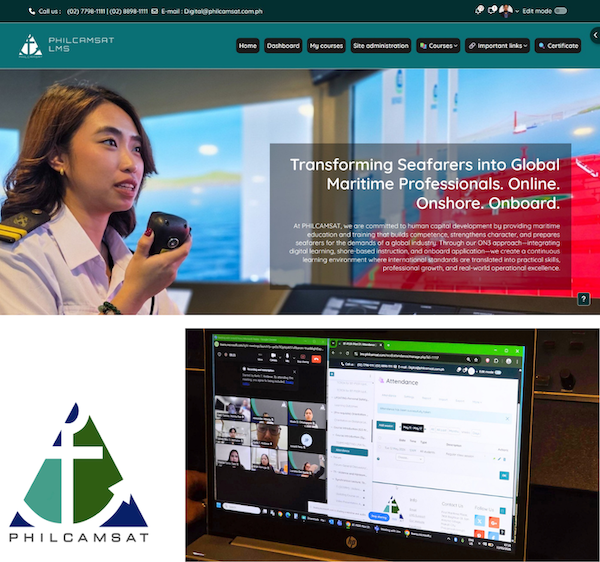
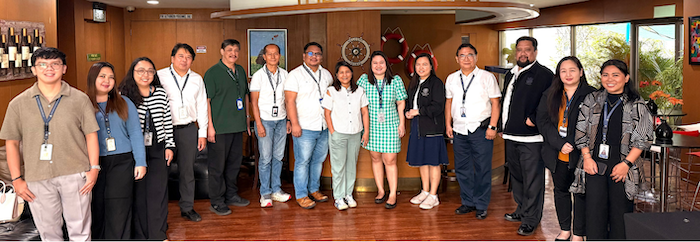
PHILCAMSAT successfully underwent a five-day MARINA inspection and accreditation audit from May 4 to 8, 2026, as part of its application to become an accredited Distance Learning Provider for STCW training programs. At the conclusion of the audit, PHILCAMSAT’s application was recommended for approval by the MARINA auditors, marking a significant milestone in the institution’s digital transformation journey.
The audit covered the key components required for the delivery of MARINA-approved Distance Learning courses. These included the accreditation of PHILCAMSAT as a Distance Learning Provider, the accreditation of its Learning Management System, the accreditation of qualified instructors and assessors authorized to conduct Distance Learning courses, and the initial Distance Learning accreditation of two STCW programs: Updating Course on Basic Training – Personal Safety and Social Responsibilities and Security Awareness Training and Seafarers with Designated Security Duties.
The inspection was conducted in accordance with MARINA Circular No. 10, Series of 2021, which provides the revised guidance on the training and assessment of seafarers through Distance Learning and E-Learning, in line with the provisions of STCW Regulation I/6. The audit reviewed PHILCAMSAT’s capability to deliver online training using an approved and properly managed Learning Management System, supported by procedures for course delivery, assessment, examination security, records management, quality assurance, and regulatory compliance.
For the initial phase, PHILCAMSAT applied for the Distance Learning accreditation of BT-PSSR Updating and SAT-SDSD as its first MARINA-accredited online STCW course offerings. These initial programs serve as the foundation for a broader Distance Learning portfolio, with additional STCW courses, including the Full Basic Training Course, planned for future implementation as part of PHILCAMSAT’s continuing digital transformation roadmap.
This initiative also marks the first major project of PHILCAMSAT’s Digital Transformation and Innovation Department, headed by C/E Mark Phillip “Chief MAKOi” Laurilla. The department was created to lead PHILCAMSAT’s transition into a more technology-enabled maritime training institution by developing, managing, and continuously improving digital learning systems, online course content, computer-based training, immersive learning tools, and future-ready training technologies.
Through the Digital Transformation and Innovation Department, PHILCAMSAT is strengthening its capability to deliver training through a blended and scalable model called ON3: Online, Onshore, and Onboard. At the center of this ecosystem is the Learning Management System, which supports structured course delivery, trainee monitoring, formative and summative assessments, anti-cheating controls, secure records, and data-driven quality improvement.
The importance of this initiative goes beyond regulatory compliance. Distance Learning gives seafarers greater flexibility and access to training, especially during periods between deployments. It also allows PHILCAMSAT to standardize course delivery, improve monitoring, reduce operational limitations, and expand its reach beyond traditional classroom-based training.
For the wider PTC Group, PHILCAMSAT’s Digital Transformation and Innovation Department can serve as a strategic resource for future digitalization initiatives. The systems, content development capability, instructional design processes, and digital training infrastructure being built by PHILCAMSAT may be leveraged for workforce development, competence tracking, online learning, company-specific training, virtual familiarization, and other technology-enabled programs across the Group.
As PHILCAMSAT continues to expand its digital training ecosystem, the successful MARINA Distance Learning accreditation audit represents an important milestone in building a more flexible, scalable, and future-ready approach to maritime education. It reinforces PHILCAMSAT’s commitment to transforming seafarers into global maritime professionals through innovation, compliance, and technology-enabled learning.